
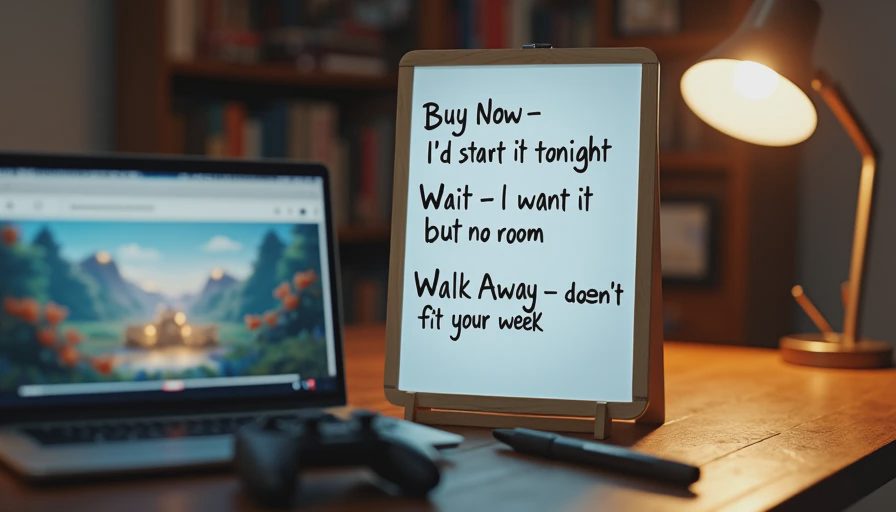
Buy now, wait, or walk away. That’s the rule I use for every new game that crosses my radar, and it’s saved me more money and frustration than any review score ever could. The logic is simple: my free time is more valuable than my disposable income. If a game doesn’t fit my life right now, it doesn’t matter how good it looks in a trailer.
I didn’t always think this way. For years, I bought games the way a lot of people do: excited, impulsive, and slightly afraid of missing out. If a game had a strong launch week, I’d convince myself I needed to play it immediately. The result was a library full of titles I started once and never touched again. I wasn’t buying games. I was buying the idea of being the kind of person who had time to play them.
That had to change. So I built a filter. It’s not complicated, and it’s not original. But it works. And if you’re an adult with a job, a commute, and maybe six hours a week to play, you need something like it.
Why the Old “Day One” Instinct Fails
The day-one purchase is built on a fantasy: that you’ll be part of the conversation, that you’ll discover something before everyone else, that the experience will be better because you were there first. For most working adults, that fantasy collapses within a week.
Here’s what actually happens. You buy the game on Friday. You play for two hours. You’re tired, so you go to bed. Saturday gets eaten by errands. Sunday you play another hour, but you’re already behind the people who marathoned it. By Monday, the conversation has moved on. You’re left with a $70 game you’ve barely started and a vague sense that you missed something.
The problem isn’t the game. It’s the timing. You bought a game for a version of yourself that had a free weekend. That version doesn’t exist anymore. And pretending he does is how backlogs are made.
The Real Cost of a Bad Purchase
A bad purchase isn’t just about money. It’s about mental clutter. Every unplayed game in your library is a small source of guilt. It sits there, reminding you that you spent money on something you didn’t use. It makes your backlog feel heavier, which makes you less likely to play anything at all.
I used to think a $5 Steam sale purchase was harmless. But ten $5 purchases add up, and none of them get played. That’s not saving money. That’s paying for guilt.
The Three-Step Rule
So how do I decide? I ask myself three questions in order. Each one filters out a different kind of bad purchase.
Step 1: Would I Start This Tonight?
This is the first and most important filter. I imagine it’s 8:30 on a Tuesday night. I’ve just finished dinner. I have maybe two hours before I need to start winding down. Would I actually start this game, or would I just scroll through the menu and go back to something comfortable?
If I can’t honestly say I’d start it tonight, I don’t buy it now. It doesn’t matter if the game is a 95 on Metacritic. It doesn’t matter if all my friends are playing it. If it doesn’t fit a tired Tuesday night, it doesn’t fit my life right now.
This filter alone eliminates most new releases. Most games are exciting in theory, not in practice. They’re exciting when you’re watching a trailer at lunch, not when you’re sitting on the couch with heavy eyelids and a controller in your hand.
Step 2: Check the Time Cost
If a game passes the “tonight” test, I look at the time commitment. Not just the advertised length, but the shape of the experience. Is it a tight 15-hour story? A 60-hour open-world epic? A live-service game with no ending?
I don’t care about “content per dollar.” That’s a trap. A 60-hour game isn’t twice as valuable as a 30-hour game. In fact, for someone with my schedule, it might be half as valuable, because I’ll probably never finish it.
What I look for is pacing and session length. Can I make meaningful progress in 45 minutes? Are there natural stopping points? Does the game respect my time, or does it demand three-hour blocks? If a game doesn’t fit my week, I wait.
Step 3: Wait for a Sale or Walk Away
If a game passes both checks, I have one more decision: buy now, or wait? I only buy now if I know I’ll start it within the next few days and I have room for it. Room means I’m not already in the middle of two other games. Room means I’m not about to travel, or work late, or lose my only free evening to a social obligation.
If I don’t have room, I wait. I put the game on a wishlist and move on. If I still want it in a month, I’ll buy it then — usually for less money. If I don’t still want it, I just saved myself $70 and thirty hours of obligation.
And if a game doesn’t pass the first two checks, I walk away. No guilt. No second-guessing. Just a clear decision that this game isn’t for me right now.
What This Looks Like in Practice
Let me give you a real example. Last month, a big open-world RPG came out. Everyone was talking about it. The trailers looked incredible. My first impulse was to pre-order.
I ran it through the filter. Would I start it tonight? No. I was tired, and the game had a two-hour tutorial before the world opened up. I didn’t want to spend my only free evening reading menus.
Time cost? The campaign was advertised at 70 hours. With my schedule, that’s three months. I wasn’t ready for that kind of commitment.
Did I have room? No. I was already playing a shorter indie game I loved, and I didn’t want to abandon it.
So I waited. Two weeks later, the discourse had cooled. I realized I didn’t actually want the game. I wanted to be part of the excitement. That’s not a good reason to spend $70. So I walked away.
The Exceptions to the Rule
No rule is perfect, and I don’t follow this one blindly. There are a few cases where I break it.
The first is if a game is from a developer I trust completely. If that studio has made three games I loved and the new one looks like a direct evolution, I might buy it at launch. Not because of hype, but because of history.
The second is if the game is genuinely short and cheap. A $15 indie game that takes five hours to finish is a different kind of risk. Even if I don’t love it, I haven’t lost much.
The third is if I’m going to play it with someone else. Co-op games, party games, anything my friends and I can share. Those are worth a day-one buy because the value isn’t just in the game — it’s in the shared time.
But those are exceptions. Maybe one or two games a year. The rest go through the filter.
What This Rule Has Taught Me
The biggest lesson from this rule isn’t about saving money. It’s about paying attention to my own desires. When I force myself to ask “Would I start this tonight?” I have to be honest about what I actually want, not what I think I should want.
That honesty is hard at first. It means admitting that a game everyone loves is not a game I want to play. It means saying no to the FOMO, no to the launch-week energy, no to the voice that says “but it’s on sale.”
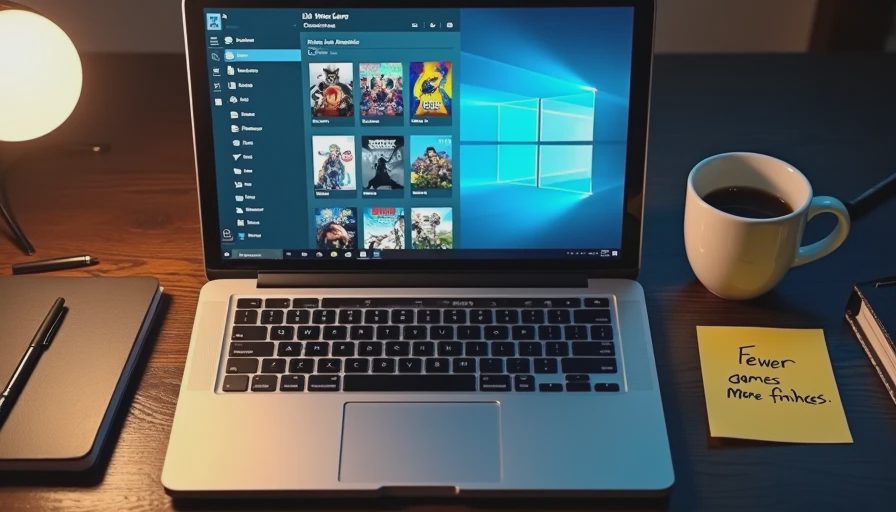
But it also means saying yes to the games that genuinely fit. A $20 indie game I finish in a week is worth more than a $70 blockbuster I quit after three hours. When I follow the rule, I buy fewer games and finish more. That’s a better trade.
The Bottom Line
Buy now, wait, or walk away. It’s not complicated, but it works. It respects your time, your money, and your taste. And in a world where every game is marketed as an event, it gives you permission to be selective.
You don’t have to play everything. You don’t have to buy everything. You just have to be honest about what fits your life right now.
The next time you’re tempted by a new release, try the three questions. Would you start it tonight? What’s the real time cost? Do you have room? If the answers don’t line up, wait. The game will still be there. Your free time won’t.



No letters yet — pray write the first.