
I’m Russ Hale. I’m 34, I live in Pittsburgh, and I still play games almost every night. But I don’t play the way I used to, and I don’t read about games the way I used to. That’s why this blog exists.
For a long time, I thought the problem was me. I’d buy a game after a week of glowing coverage, play it for three hours, and feel nothing. Then I’d quit, feel guilty, and repeat the cycle. I’d scroll through launch threads on Reddit and see thousands of people celebrating a game I found exhausting. I started to wonder if I had fallen out of love with games.
I hadn’t. I had fallen out of love with the hype machine. And I don’t think I’m alone.
Most adults I know who still play games live with a strange tension. They love the medium deeply, but they no longer have the time or energy to treat every new release like an event. Their backlogs are full of games they bought out of excitement and abandoned out of exhaustion. They don’t need more recommendations. They need better judgment. That’s what I want to offer here.
The Moment I Stopped Caring About Launch Week
A few years ago, I took a Friday off work to play a major RPG that had been marketed as “the next evolution of the genre.” I had watched every trailer, read early impressions, and told myself this would be the game that made me feel like I did in college — when a weekend could disappear into a world without guilt.
Friday night was fine. The game was beautiful. The systems were deep. I played until one in the morning and went to bed feeling optimistic.
Saturday was different. I woke up late, made coffee, and sat down to play. The game was still beautiful, but I started noticing how much of my time was spent walking between objectives, managing inventory, and clearing map icons. By Saturday night, I was playing out of obligation. I had already told people I was spending the weekend with this game. Quitting felt like admitting I had been wrong.
Sunday morning, I sat on the couch with the controller in my lap and stared at the screen. I had played eleven hours. I didn’t hate it. But I realized I was forcing myself to keep going because I had already invested time and money, not because I was excited to see what happened next. That Sunday, I wrote in my notebook: “Some games are built to be talked about, not played.”
That sentence became the seed of this blog.
I don’t think launch-week excitement is worthless. I just think it’s aimed at a different person than me. It’s aimed at the version of me who had forty hours a week to spare, no job, no rent, and no sense of what a weekend actually costs. I’m not that person anymore. And if you’re reading this, you probably aren’t either.
What “Worth Your Time” Actually Means for an Adult Player
As an adult with a full-time job and a life outside games, I ask a different question now. Not “Is this game good?” but “Is this game worth bringing into my week?”
That sounds simple, but it changes everything. A game can be technically impressive, critically acclaimed, and absolutely not worth my time. A game can be ugly, janky, and short, and still earn a permanent place in my memory.
For me, a game is worth my time if it does at least one of three things:
It gives me a real sense of discovery or mastery in the first few hours, not just a promise that it gets better after ten.
It respects my limited session length — I can play for forty-five minutes and feel like something happened.
It leaves an emotional residue after I turn it off. I think about it at work. I want to talk about it.
That last one is the most important. I’ve played polished games that I forgot by the next morning, and I’ve played rough games that stayed with me for months. Staying power matters more than polish.
Take Return of the Obra Dinn. It’s not a big game. The graphics are deliberately grainy. The interface is minimal. But I finished it in two evenings and thought about it for a week. That’s worth more to me than a 60-hour open-world game I’ll never finish.
This Blog Is Not a Review Site
I should be clear about what Last Save Tonight is not. It’s not a review outlet. I don’t have review codes, I don’t chase embargoes, and I don’t score games out of ten. I don’t care whether a game is a “masterpiece” by industry standards. I care whether it respects the time of a person who has maybe two free evenings a week.
I also won’t spoil major story beats for traffic. If I talk about a game’s ending, I’ll tell you in advance. I’d rather you experience a good story yourself than read a summary on this blog.
What I will do is write honestly about games from the perspective of a long-term player. I’ll compare how a game feels now to how it felt when I was younger. I’ll admit when I’m wrong. I’ll update my opinions when a game changes with a patch or a replay. And I’ll never tell you to buy something just because it’s popular.
There’s also a practical side to this blog: I’ll talk about money. Not in the sense of “this game is worth $70,” but in the sense of “this game costs $70 plus thirty hours of your life, and you need to know what you’re getting into before you commit.” Most review scores don’t account for that second cost. I do.
The Notebook I Keep by the Couch
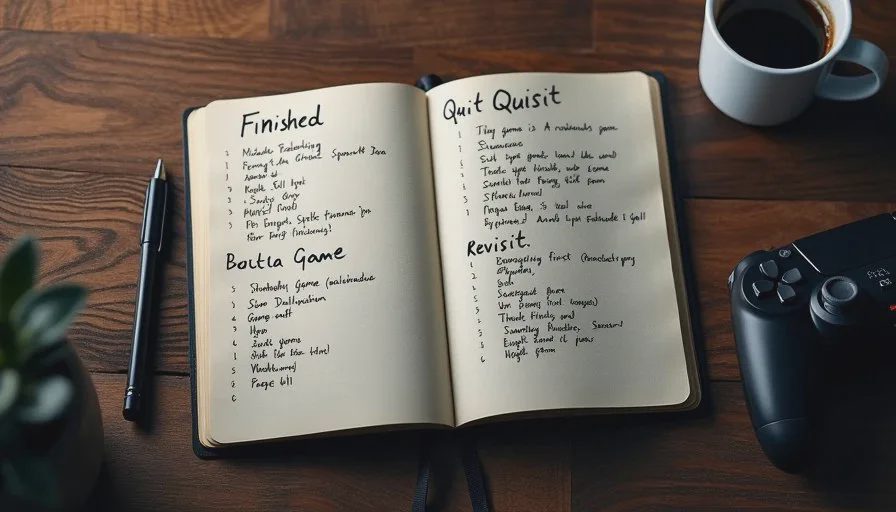
Near my couch, under the coffee table, there’s a small black notebook. In it, I keep three lists: games I finished, games I quit, and games I want to revisit. Next to each title, I write a one-sentence note about why I stopped or why I stayed.
Some entries are short: “Elden Ring — stopped at 40 hours, not because it was bad, but because I ran out of steam and knew I’d never get the ending I wanted.” Others are more personal: “Disco Elysium — quit twice, then played it in one week during a snowstorm and now I think about it every winter.”
That notebook is the raw material for this blog. When I write about quitting a game in the first three hours, it’s not a hot take. It’s a pattern I’ve noticed over fifteen years of playing. When I write about replaying Dishonored or Mass Effect 2, it’s because I actually did — last winter, or last month, not in a YouTube video I watched.
I also have a habit of replaying one old favorite every winter to see if it still hits the same way. Some games age. Some games deepen. That winter replay is my test for the difference, and I’ll write about it here.

What You’ll Find Here (and What You Won’t)
Last Save Tonight is built around a few simple questions: Is it worth the hours? Does it still hold up? What does it mean after the credits? And does it deserve a spot on your shelf?
You’ll find judgment-first recommendations for busy adult players. You’ll find essays about gaming through different life stages — why I don’t need to finish every good game anymore, why quitting can be a relief, why some 20-hour games feel longer than 70-hour RPGs. You’ll find practical guides for deciding what to buy, what to skip, and what to wait for a sale on.
You’ll also find comparisons that most outlets avoid because they’re not tied to launch windows. Things like “If you miss old BioWare, here are five games that still scratch the itch” or “Steam sale trap: the games most likely to rot in your library.” I write those because they matter to people who don’t have time to scroll through a hundred store pages.
You won’t find empty “10/10 masterpiece” praise. You won’t find hype pieces timed to a launch window. You won’t find me pretending that every new release matters.
Some games meet you where you are. Some just want your weekend. I’m here to help you tell the difference.
If that sounds like the kind of game writing you’ve been missing, welcome. Pull up a chair. It’s late, but we’ve got time for one more save.




No letters yet — pray write the first.