
Staying power is the rarest quality in games. It's not the same as length, polish, or even enjoyment. A game can be fun for twenty hours and vanish from your memory the moment you turn it off. A game can be rough around the edges and still haunt you for years. Staying power isn't about what a game is. It's about what it leaves behind.
I've been thinking about this a lot lately, because my gaming time is more limited than ever. When I finish a game — or when I quit one — I want to know: was it worth it? Did it change something in me? Will I remember it in five years?
Those are hard questions, and most review scores don't answer them. A 9 out of 10 tells you a game is good. It doesn't tell you whether it will stay with you after the credits roll.
So I developed a personal test. It's not scientific. It's not universal. But it helps me figure out which games actually have staying power — and which ones I'll forget by next month.
What Staying Power Means
Before I explain the test, let me define what I mean. Staying power is the quality of lingering. A game with staying power doesn't end when you put down the controller. It follows you. You think about it at work. You talk about it with friends. You catch yourself replaying scenes in your head. It becomes part of your mental furniture.
Some games earn this through story — a character whose fate you can't shake. Some earn it through systems — a mechanic so satisfying you crave it when you're away. Some earn it through atmosphere — a world that feels more real than your own living room.
But whatever the source, the result is the same: the game sticks. It becomes a reference point, a memory, a piece of who you are as a player.

The Three-Week Test
The core of my test is simple: three weeks after I finish a game, I ask myself if I still think about it.
That's the whole test. Not "did I enjoy it?" Not "was it well made?" Not "would I recommend it?" Just: do I still think about it?
Three weeks is the right interval because it's long enough for the hype to fade and short enough that a truly powerful experience hasn't lost its edge. If a game still surfaces in my thoughts after three weeks — if I still care about its characters, still wonder about its world, still feel the residue of its ending — then it has staying power.
Most games fail this test. I finish them, I feel satisfied or disappointed, and then I move on. A week later, they're already fading. Three weeks later, they're gone.
But the games that pass — those are the ones worth cherishing. They're rare, and they're precious.
Examples That Passed
Disco Elysium passed the test easily. Three weeks after I finished it, I was still thinking about its characters, its politics, its strange blend of humor and despair. A year later, I still think about it.
Outer Wilds passed. That game burrowed into my brain and stayed there. The ending — which I won't spoil — recontextualized the entire experience. Three weeks later, I was still unpacking what it meant.
Silent Hill 2 passed. I played it years ago, and I still think about the fog, the monsters, the final confrontation in the hotel. That's staying power on a different scale.
Examples That Failed
I won't name names here, because the point isn't to shame anyone. But I've played plenty of games that were fun, polished, and completely forgettable. Big-budget action games where the combat was satisfying but the story evaporated the moment it ended. Open-world RPGs where the map was beautiful but the experience was hollow. They were good games. They just didn't stick.
That doesn't mean they were bad. It means they weren't memorable. And for a busy adult, memorability matters. If I'm going to spend my limited time on a game, I want it to leave a mark.
The Secondary Tests
The three-week test is the core, but it's not the only thing I look for. Over the years, I've developed a few supplementary checks that help me predict staying power before I even finish a game.
The "Can't Stop Thinking About It" Test
This one happens during play, not after. If I'm at work, or cooking dinner, or walking through my neighborhood, and I catch myself thinking about the game — not just planning my next session, but actually turning over its ideas, its characters, its implications — that's a sign.
Games with staying power invade your mental space. They don't wait for you to pick up the controller. They come to you.
Hades did this. I'd be at work, thinking about a build I wanted to try, a dialogue scene I'd just unlocked, a boss I'd almost beaten. The game lived in my head between sessions. That's when I knew it was special.
The "Talk About It" Test
Another sign: do I want to talk about the game? Not just "it's good, you should play it" — but actually discuss it, argue about it, unpack its themes and choices?
Games with staying power generate conversation. They give you something to chew on, something to share. I've had hour-long conversations about Disco Elysium and The Last of Us Part II — conversations that felt like talking about a great book or film, not just a piece of entertainment.
If a game doesn't give me anything to say, it probably won't stay with me. The best games leave you with questions, not just memories.
The "Replay It in My Head" Test
This is the most subtle one. Some games, after I finish them, I replay scenes in my head. Not the gameplay — the moments. The emotional beats, the quiet conversations, the sudden realizations. I see them again, like scenes from a movie I can't stop thinking about.
Mass Effect 2 does this. I think about Mordin's loyalty mission, about the suicide mission's final moments, about the quiet conversations on the Normandy. Those scenes replay in my head years later, without any prompting.
That's staying power: when a game's moments become your memories.
What Staying Power Requires
Not every game needs staying power. Some games are meant to be enjoyed and forgotten — like a good action movie or a satisfying meal. There's nothing wrong with that. I play plenty of games that don't pass my test, and I enjoy them fine.
But for a busy adult, staying power matters more than it used to. When I was younger and had unlimited time, I could afford to play games that vanished from my memory. Now, every game competes for a limited slice of my week. I want that slice to mean something.
The Difference Between Fun and Meaningful
Fun is easy. Meaningful is hard. A game can be fun without being meaningful — that's most games. A game can be meaningful without being fun — that's rare, but it happens. The games with real staying power are usually both: fun enough to keep you playing, meaningful enough to keep you thinking.
That's a high bar. Most games don't clear it. But when one does, it reminds me why I love this medium.
How to Apply the Test
If you want to develop your own staying power test, start with the three-week rule. Finish a game. Wait three weeks. Then ask yourself: do I still think about it?
The answer will tell you more than any review score. It will tell you whether the game actually mattered to you — not whether it was well made, not whether it was popular, but whether it left something behind.
And if you want to predict staying power before you finish, pay attention to the signs. Do you think about the game between sessions? Do you want to talk about it? Do you replay its moments in your head? Those are the early indicators. If they're present, the game is probably going to stick.
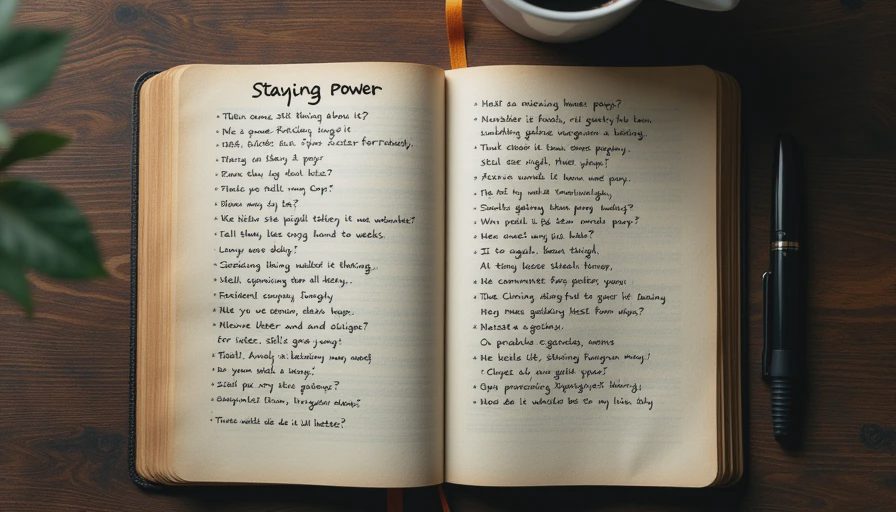
The Games Worth Keeping
I keep a list of games that passed my staying power test. It's short — maybe ten or fifteen titles, accumulated over two decades of playing. These are the games I recommend without hesitation, the games I return to when someone asks "what should I play next?"
They're not all masterpieces by critical standards. Some of them are flawed, rough, even frustrating. But they all share one quality: they stayed with me. They passed the test. They proved their worth not in the first week, but in the weeks and years after.
That's what I'm looking for when I start a new game. Not just a good time. Not just a polished experience. I'm looking for something that will still be with me in three weeks, in three months, in three years.
Some games meet you where you are. Some just want your weekend. And a very few — the ones with real staying power — walk with you for the rest of your life.
Those are the ones worth your time.





No letters yet — pray write the first.