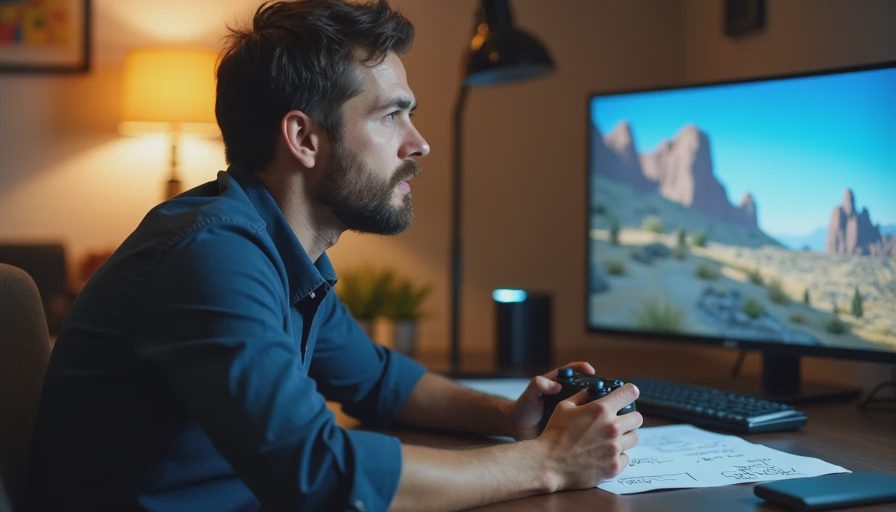
Before I start any 60-hour game, I go through a mental checklist. Not because long games are bad — some of my favorite experiences have been hundred-hour epics — but because a long game is a different kind of commitment. It’s not a one-night stand. It’s a relationship. And if I’m going to invest three months of my limited gaming time, I need to know the relationship has a future.
For a busy adult, a 60-hour game isn’t just 60 hours. It’s sixty hours squeezed into the margins of a full-time job, a commute, errands, and the small logistics of staying alive. If I play six hours a week — which is a good week — that’s ten weeks. Two and a half months. That’s a season of my gaming year.
So before I press start, I ask myself a series of questions. They’ve saved me from wasting dozens of hours on games that looked great in trailers but collapsed under their own weight by hour thirty.
Question 1: Will I Still Enjoy the Core Loop at Hour 40?
The core loop is the thing you do over and over again — combat, exploration, dialogue, crafting, whatever the game is built around. In the first few hours, almost any loop can feel fresh. The real test is whether it still feels good at hour 40, after you’ve seen the same enemy type twenty times and opened the same kind of chest fifty times.
I learned this lesson the hard way with a big open-world RPG a few years ago. The first ten hours were great. The combat was crunchy, the world was beautiful, and I was discovering new things constantly. But by hour thirty, the cracks started to show. Every fight felt the same. Every dungeon followed the same pattern. The game wasn’t introducing new mechanics anymore — it was just scaling up the numbers.
If a game doesn’t introduce meaningful new systems, enemies, or challenges in its second half, it’s not a 60-hour game. It’s a 15-hour game with 45 hours of repetition. And I don’t have 45 hours to spend on repetition.
How I Test the Core Loop
I watch late-game footage. Not trailers — actual gameplay from people who are 40 or 50 hours in. Does the combat look different from hour five? Are there new mechanics, new abilities, new enemy behaviors? Or is it the same thing with bigger health bars? If the latter, I know the game will lose me before the credits.
Question 2: Does the Story Have Momentum, or Just Length?
A long game needs a story that pulls you forward. Not necessarily a complex plot — some great long games have simple stories — but a sense of momentum. You should always feel like something is about to happen, like the next story beat is worth reaching.
I’ve quit several long games because the story lost me. Not because it was bad, but because it stopped moving. I’d reach a new area, get a new quest, and realize I didn’t care anymore. The game had become a list of tasks instead of a narrative.
The best long games understand this. The Witcher 3 works because every side quest has a story — often a better story than the main plot. Persona 5 Royal works because the daily loop is constantly building toward the next deadline, the next boss, the next reveal. Elden Ring works because the world itself is the story, and every corner hides something that changes how you understand it.
The Red Flag
If a game’s story is described as “slow burn” or “takes a while to get going,” I’m cautious. That’s often code for “the first twenty hours are a slog.” A slow burn can work if the payoff is real, but most of the time, it’s just slow.
Question 3: Does It Respect My Session Length?
This is the most practical question, and for a busy adult, it’s often the most important. Can I play this game in 45-minute chunks and still feel like I made progress?
A game that demands three-hour sessions is a game I can’t play on a Tuesday. I might love it on a weekend, but my weeknights are too fragmented. If the game has no natural stopping points, if the save system punishes me for leaving, if the missions are so long that I can’t finish one in a single evening — then it’s not a weekday game. And if it’s not a weekday game, it’s not going to fit my life.
What Good Session Design Looks Like
Persona 5 Royal is built around days. You do a day, then you save. You can stop after any in-game day and feel like you’ve completed a chapter. Elden Ring is built around sites of grace. You can push to the next grace, then stop. The Witcher 3 has short quests that can be finished in a single sitting. These games respect the fact that adults have to stop playing sometimes.
A game that doesn’t respect that is a game that’s fighting against my schedule. And my schedule always wins.
Question 4: Am I in the Right Headspace for This?
This one is easy to overlook, but it matters. A 60-hour game is not just a time commitment — it’s an emotional commitment. You’re going to live in this world for months. You’re going to carry its characters, its tone, its demands on your attention.
If I’m tired, stressed, or already juggling too many things, I shouldn’t start a long, dense RPG. I should play something shorter, something that doesn’t ask me to remember a dozen systems and care about a dozen characters.
I made this mistake with Disco Elysium. I bought it, started it, and quit twice because I wasn’t in the right headspace. The game demands focus and emotional availability. I didn’t have either. Then, during a quiet winter week, I started it again and finished it in five days. It was the right game at the wrong time, and I had to wait for the right time to arrive.
The Honest Question
Before starting a long game, I ask myself: “Am I looking forward to this, or am I just trying to fill time?” If it’s the latter, I don’t start. A long game should be something you anticipate, not something you use to kill an evening.
Question 5: Is the Ending Worth the Journey?
This is the hardest question, because you can’t know the ending until you’ve played the game. But you can look for signals. Does the game have a reputation for sticking the landing? Do players who finished it feel satisfied, or do they complain about a rushed third act?
I’ve sunk 50 hours into games that fell apart in the final ten. The story collapsed, the combat became a grind, or the ending was so unsatisfying that it retroactively ruined the journey. That’s the worst feeling in gaming: investing months of your life into something that doesn’t pay off.
How to Check Without Spoiling Yourself
Read reviews that focus on structure rather than plot. Look for phrases like “the final act drags” or “the ending lands.” Avoid detailed spoilers, but pay attention to the overall consensus. If the ending is divisive, I wait. If it’s praised, I’m more willing to commit.
Question 6: Do I Already Have a Long Game on the Go?
This is a rule I learned the hard way: never start two long games at the same time. It always ends badly.
When I was younger, I’d juggle three or four big RPGs at once. I’d lose the thread of each story, forget the controls, and eventually abandon all of them. Now I have a strict policy: one long game at a time. I finish it, or I consciously quit it, before starting another.
If I’m already 30 hours into something, starting a new 60-hour game means I’ll either abandon the old one or neglect the new one. Neither feels good. So I wait.

What a Good 60-Hour Game Feels Like
When all these questions line up, a long game can be one of the best experiences in gaming. It becomes a ritual — something you look forward to every evening, like a great TV show you watch one episode at a time. You think about it during the day. You miss the characters when you’re away. You finish it with a mix of satisfaction and loss, because the world is over and you have to leave.
That’s what Persona 5 Royal did for me. That’s what The Witcher 3 did. That’s what Elden Ring did. They earned their length because every hour mattered, or at least most hours did.
The Final Check
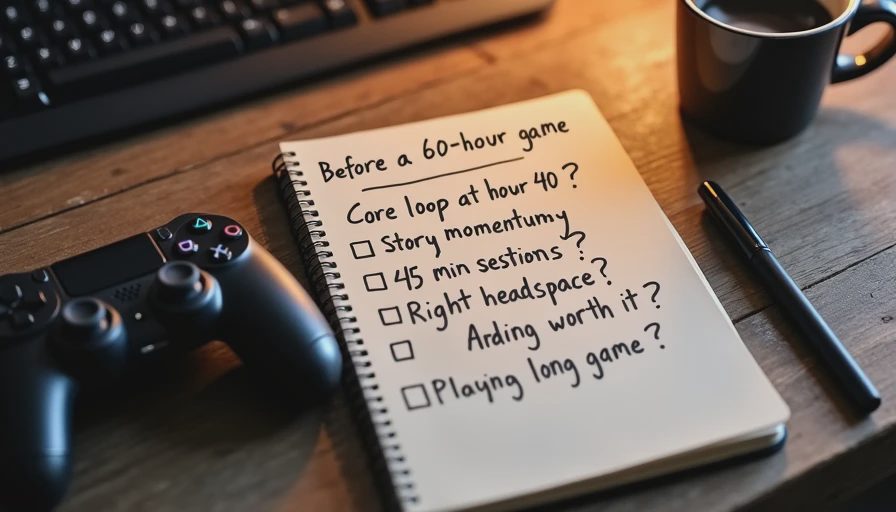
So before I start any 60-hour game, I run through the list:
Will the core loop hold at hour 40?
Does the story have momentum, or just length?
Can I play in 45-minute sessions?
Am I in the right headspace?
Is the ending likely to be worth it?
Am I already playing another long game?
If the answer to any of these is no, I don’t start. It doesn’t mean the game is bad. It just means it’s not right for me right now. And that’s okay. The game will still be there when I’m ready.
Some games meet you where you are. Some just want your weekend. And a 60-hour game wants your season. Make sure it’s worth it.




No letters yet — pray write the first.