
Not every good game is worth your time right now. That sounds contradictory. A good game should always be worth playing, right? But time is a context, not a constant. A game that would have meant everything to you at 21 might feel hollow at 34. A game that’s perfect for a long weekend might be miserable during a busy work week. The game hasn’t changed. You have.
I’ve made this mistake more times than I can count. I’ve started games that were critically acclaimed, beautifully crafted, and absolutely wrong for my current life. I pushed through, expecting them to click, and ended up resenting them. Not because they were bad, but because the timing was wrong.
Here’s what I’ve learned about timing, and how to tell if a good game is actually right for you right now.
The “Right Game, Wrong Time” Problem
The problem starts with how we talk about games. Reviews, recommendations, and top ten lists all assume that a good game is good for everyone, at any time. But that’s not true. A game exists in a context: your energy level, your schedule, your mood, your life stage.
Take The Witcher 3. It’s one of the best RPGs ever made. I loved it when I played it. But I played it during a quiet winter when I had long, uninterrupted evenings to sink into its world. If I tried to play it during a busy month at work, I’d probably bounce off it. The game would be the same. My capacity to receive it would be different.
Quality Is Universal. Fit Is Personal.
Quality is universal. The Witcher 3 is a great game no matter who you are. But fit is personal. Whether that great game fits into your life right now depends on a dozen factors that reviews never mention.
How tired are you? How much mental energy do you have after work? Do you have two free evenings this week, or two free hours? Are you in the mood for something heavy, or something light? These questions matter more than metacritic scores.
A game can be a masterpiece and still be a bad fit for your current life. That doesn’t mean the game failed. It means the timing wasn’t right.
How to Tell If a Game Fits Right Now
I’ve developed a few practical checks that help me decide whether a good game is worth starting now or worth waiting for later.
Check Your Energy Level
This is the first and most honest question. After a long workday, what kind of experience are you actually capable of enjoying?
Some games demand focus. They ask you to learn systems, pay attention to dialogue, and make decisions that matter. Disco Elysium is like this. Elden Ring is like this. They’re great games, but they’re not “tired Tuesday night” games.
Other games are gentler. They’re built for winding down — shorter sessions, forgiving mechanics, a tone that doesn’t punish you for being tired. A game like Stardew Valley or Unpacking fits that space.
Neither type is better. The question is which type you need right now. I’ve started too many demanding games on nights when I was exhausted, then quit them in frustration. The problem wasn’t the game. It was me trying to force a square peg into a tired round hole.
Look at Your Schedule
This one is practical. How much time do you actually have in the next two weeks? Not how much you wish you had — how much you really have.
If you have a free weekend coming up, a 15-hour game might be perfect. You can start Friday night, play through Sunday, and finish it. That’s a complete experience.
If you have fifteen minutes a night, a sprawling RPG will feel like a burden. You’ll spend more time loading saves and re-learning controls than actually playing. The game will feel worse than it is, because your schedule doesn’t match its needs.
I’ve learned to be honest about this. A game that demands three-hour sessions is not a game I can play during a busy month. I put it on my wishlist and wait for a calmer season.
Ask What You’re Actually Craving
This is the subtle one. Sometimes I think I want a deep strategy game, but what I actually need is a short action game with a clear win condition. Recognizing the difference saves me from buying the wrong thing.
I’ve started keeping a mental note of what I’ve been playing and how I felt during those sessions. If I’ve been playing long RPGs and feeling drained, I probably need something lighter. If I’ve been playing quick indies and feeling bored, I might need something with more depth.
The key is to pay attention to your own reactions. Don’t just play what you think you should play. Play what you actually need.

The Permission to Wait
You’re allowed to put a good game on hold. Not every game needs to be played immediately. Some games are better saved for a vacation, a slow season, or a different mood. The game will still be there when you’re ready.
This took me a long time to internalize. I used to feel guilty about my backlog — all those good games waiting unplayed. I’d force myself to start them even when I wasn’t in the right headspace, because I felt like I owed them my attention.
That’s backwards. A backlog isn’t a to-do list. It’s a pantry. You don’t eat everything in your pantry tonight. You choose what fits the meal you’re cooking. The same goes for games.
My Personal Example
I bought Disco Elysium on sale in 2022. I started it three times. Each time, I quit after an hour. The game was dense, wordy, and emotionally heavy. I wasn’t in the right place for it. I was tired, distracted, and impatient. I thought the game was overhyped.
Then, one winter, everything changed. The days were short, the weather was cold, and I was in the mood for something slow and thoughtful. I started Disco Elysium again. I finished it in a week. It was the right game at the right time.
The game hadn’t changed. I had. And that’s the point.
The Danger of Forcing It
Forcing yourself to play a good game at the wrong time is worse than not playing it at all. It poisons the experience. You associate the game with frustration, boredom, or exhaustion. Then, when the right time finally comes, you don’t want to play it anymore, because you remember how it made you feel.
I’ve done this. I’ve started games I knew I wasn’t ready for, pushed through a few hours, and quit. Then I never went back, because the memory of those frustrating sessions outweighed the game’s reputation.
The lesson: don’t force it. If a game doesn’t fit right now, wait. Your time is too limited to spend it on an experience you’re not ready to receive.
How to Wait Well
Waiting doesn’t mean forgetting. It means putting the game somewhere you’ll see it when the time is right.
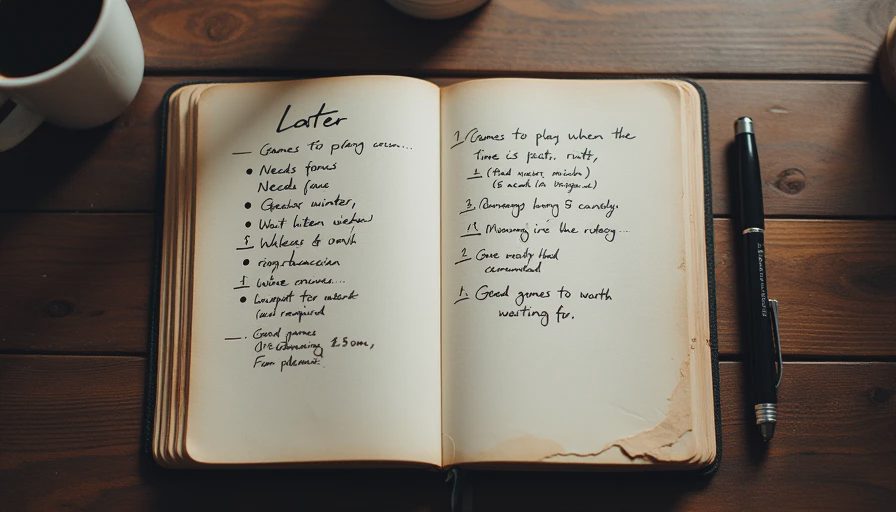
I keep a list of “later” games — games I know are good but don’t fit my current season. When I finish something and I’m looking for the next thing, I check that list first. Usually, one of those games will feel right. The timing will have shifted.
This approach has changed how I play. I finish more games, because I only start them when I’m ready. I enjoy them more, because I’m not fighting against my own tiredness. And I appreciate good games more, because I let them meet me where I am instead of forcing them into a space that doesn’t fit.
The Bottom Line
Not every good game is worth your time right now. That’s not an insult to the game. It’s a recognition that you are a person with limits — limited energy, limited hours, limited emotional capacity. A good game, like a good meal, is best enjoyed when you’re hungry for it, not when you’re already full.
So before you start that masterpiece everyone keeps recommending, ask yourself: Am I ready for this? Do I have the energy? Do I have the time? Am I actually craving it, or am I just checking a box?
If the answer is no, wait. The game will still be there. And when the time is right, it will meet you where you are.
Some games meet you where you are. Some just want your weekend. And some, the truly great ones, are worth waiting for the right moment to play.




No letters yet — pray write the first.