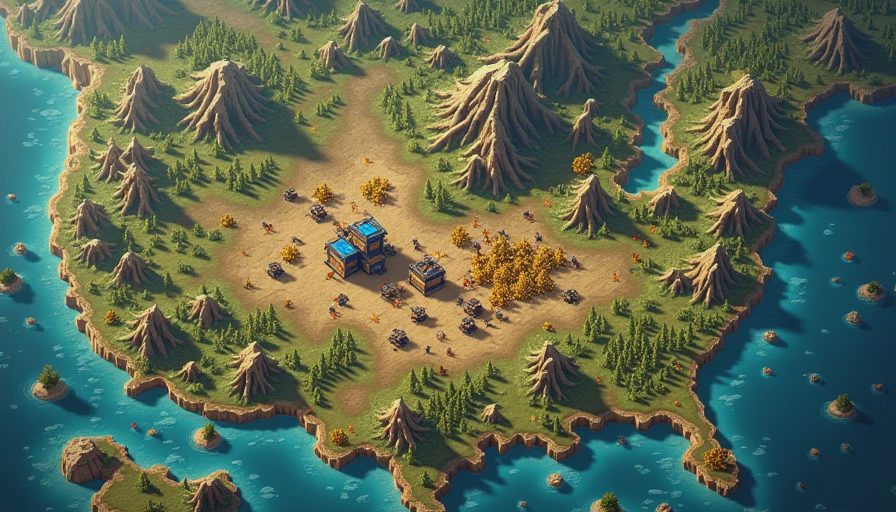
odern games have a size problem. They keep getting bigger — bigger maps, bigger skill trees, bigger promises — but they rarely get more worthwhile. I’ve spent enough evenings staring at a map full of icons to know that scale and meaning are not the same thing. And yet the industry keeps selling us bigness as if it were a feature.
I first noticed this a few years ago, when a friend asked me why I’d quit a well-reviewed open-world game after twenty hours. I told him the truth: I didn’t quit because the game was bad. I quit because it was full. Full of tasks, full of markers, full of systems that existed mostly to justify the size of the map. The actual fun — the story, the combat, the sense of place — was buried under hours of busywork.
That’s when I started paying attention to the difference between a game that is big and a game that is worthwhile. They are not the same thing, and confusing them costs busy adults more than money. It costs time we don’t have.
The Rise of the Inflated Open World
Open worlds used to be rare. When I was in college, a game like Grand Theft Auto III or Morrowind felt revolutionary because it offered a kind of freedom we hadn’t seen before. The size was the point. The world itself was the discovery.
Now open worlds are the default template for any game with a marketing budget. Every major release promises “a massive world to explore.” But what you actually get is often a series of repetitive tasks scattered across a map that’s larger than it needs to be.
Copy-Paste Content Isn’t Exploration
Real exploration is about curiosity and discovery. You see something interesting on the horizon, you walk toward it, and you find something unexpected — a story, a secret, a view that changes how you understand the world.
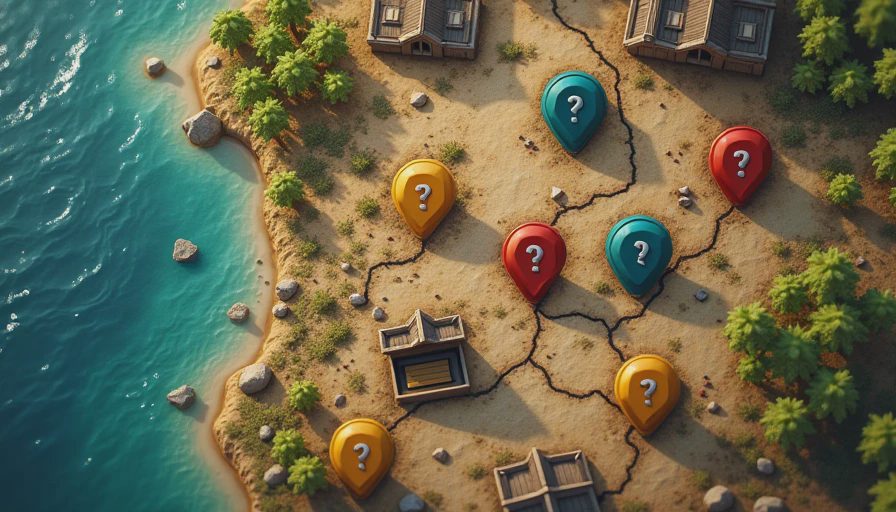
Fake exploration is about clearing icons off a map. You open the map, see forty bandit camps, ten towers, and a hundred collectibles, and you start checking boxes. That’s not exploration. That’s a to-do list with a minimap.
The difference matters because one respects your time and the other wastes it. A game that trusts you to explore rewards curiosity. A game that fills the map with icons is just keeping you busy.
The Cost of Padding
Every hour of filler comes at a cost. It doesn’t just waste your time — it dilutes the good parts. A tight 20-hour game becomes a bloated 60-hour one because the publisher demanded more “content.” The story loses momentum. The pacing suffers. The characters stop developing because they’re stuck repeating the same mission template for the fifth time.
I’ve seen this happen to franchises I love. A series that used to deliver a sharp, focused experience suddenly decides it needs to be an open world with crafting, hunting, and fifty hours of side content. The result is almost always the same: a game that’s longer but weaker. More to do, less reason to care.
For a busy adult, that trade-off is especially brutal. I don’t have fifty hours to spend on a game that only has twenty hours of real ideas. I need the game to respect my time by knowing what it is and not padding the runtime.
What “Worthwhile” Actually Means
So if bigness isn’t the measure, what is? For me, a worthwhile game is one that gives you something in return for your time. It might be a memorable story, a new mechanic, a sense of mastery, or an emotional payoff. It doesn’t need to be huge. It needs to be meaningful.
Depth Over Scale
Depth and scale are not the same thing. A small game can be incredibly deep — Outer Wilds is a tiny solar system, but every planet matters, every clue connects, and the whole experience is built around your own curiosity. A huge game can be incredibly shallow — a map the size of a country with nothing in it but the same three activities repeated until your thumb falls off.
When I judge a game now, I don’t ask how big it is. I ask how dense it is. How many meaningful decisions does it offer per hour? How much of the runtime is actually moving the experience forward? A 15-hour game with no filler is worth more to me than a 70-hour game with 50 hours of filler.
Examples That Get It Right
Hades is a short loop — one escape attempt takes about thirty minutes — but every run teaches you something new about the characters, the story, or the systems. It’s not big, but it’s dense with meaning. I played it for sixty hours and never felt like I was wasting time.
Disco Elysium takes place in a small city block, but every conversation is dense with philosophy, humor, and consequence. It’s one of the richest games I’ve ever played, and it barely has a map at all.
Return of the Obra Dinn is a single ship. You walk around it, looking at frozen moments of death, trying to identify the crew. It’s maybe eight hours long. But I thought about it for weeks afterward. That’s worthwhile.
Compare that to a 100-hour open-world game where I spend ten hours fast-traveling between map markers. The big game gives me more hours per dollar, but the small game gives me more meaning per evening. I know which one I prefer.
How to Spot the Difference
So how do you tell if a big game is worth your time? I’ve developed a few questions I ask before buying.
Question 1: Why Is It Big?
Is the size serving the experience, or is it just a marketing bullet point? If the developers talk more about map size than about pacing, mood, or story, be skeptical. A game that’s proud of being “ten times bigger than our last game” is usually ten times emptier too.
Question 2: What Am I Actually Doing Per Hour?
Look at gameplay footage, not trailers. Trailers show the highlights. Real gameplay shows the walking, the menu management, the repeated encounters. If half of every session is spent traveling or clearing inventory, that’s padding.
Question 3: Can I Make Progress in 45 Minutes?
This is the adult player’s test. If a game can’t give you a meaningful chunk of experience in forty-five minutes, it doesn’t fit your life. Long games can work, but only if they’re designed around natural stopping points and satisfying sessions.
Question 4: Do I Care About the World, or Just the Icons?
This one is more personal. When you see a new area on the map, are you excited to explore it, or are you already planning the fastest route to clear the markers? If it’s the latter, the game has already failed you.
The Real Cost of Confusing Big With Worthwhile
The industry keeps making bigger games because bigger is easier to market. “Over 100 hours of content” sounds impressive in a store description. “A small, focused experience you’ll remember for years” doesn’t fit on a box art.
But the cost is real. Bigger games take longer to make, cost more to buy, and demand more of your time. They crowd out smaller, more focused experiences that might have changed how you think about games. And they train players to expect padding, so developers keep padding, and the cycle continues.
For a busy adult, the stakes are higher. You don’t have a hundred hours to give to a game that only has twenty hours of ideas. You have maybe two evenings a week, and you need to spend them on games that respect that time.
So the next time a game boasts about its enormous map, its endless quests, its “hundreds of hours of gameplay,” pause. Ask yourself: is this big, or is this worthwhile? They are not the same thing.
And if you can’t tell the difference yet, start with a game like Outer Wilds or Hades. Play it for a week. See what it feels like to play something that values your time as much as you do. Then go back to the big open-world game and see if it still feels the same.
Some games meet you where you are. Some just want your weekend. The big ones usually want your whole month. Choose accordingly.




No letters yet — pray write the first.